
Joint Compound vs Spackle: Which One Should You Use for Wall Repair?
If you are repairing a wall before painting, choosing between joint compound vs spackle usually comes down to one simple question: How large and what type of damage are you repairing?
Spackle is generally the more convenient choice for small nail holes, shallow dents and minor surface damage. Joint compound is typically better suited to drywall seams, larger repairs and jobs where you need to spread material over a broader area.
That does not mean one product is universally better. They are made for different types of work and using the wrong material can make a repair harder to sand, more difficult to blend or less suitable for the job. Here is how to tell the difference and choose the right one before you pick up a putty knife.
TL;DR
- Spackle is generally suited to small holes, nail holes, dents and minor wall damage.
- Joint compound is primarily used for finishing drywall joints and can also be used for many larger surface repairs.
- Spackle is often convenient for quick spot repairs because it is made specifically for patching small imperfections.
- Joint compound is usually the more practical choice for drywall seams and larger areas that require spreading and feathering.
- Either material can be painted after the repair has dried and been properly prepared.
- Neither product eliminates the need for sanding, dust removal and appropriate surface preparation.
- For recurring cracks, water damaged drywall, extensive damage or difficult texture matching, the underlying problem may need to be addressed before patching.
What Is Joint Compound?
Joint compound is a gypsum based material commonly used in drywall finishing. It is often called drywall mud.
Its primary job is to finish the joints between sheets of drywall. Drywall panels meet along seams, and those joints need to be reinforced and covered so the finished wall looks continuous rather than showing visible lines.
A typical drywall joint is finished with joint tape and several applications of joint compound. The compound is spread over the taped seam, allowed to dry and then sanded or otherwise prepared for the next coat. Each application gradually widens the finished area, which helps hide the transition between the drywall panels.
Joint compound is also useful for certain repairs beyond seams. Depending on the product and the size of the repair, it can be spread over dents, damaged areas and larger patches.
One important characteristic is that joint compound is intended to be spread relatively thinly over larger areas. It is not simply a heavier duty version of spackle.
Different joint compounds also have different properties. Some are premixed, while others are supplied as a powder that is mixed with water. Setting type compounds harden through a chemical reaction and are available in products intended for different working times. Drying type compounds harden as moisture leaves the material.
That distinction matters when planning a repair because the working and drying characteristics can vary considerably from one product to another.
What Is Spackle?
Spackle is a wall patching material intended primarily for repairing small imperfections. It is commonly used for:
- Nail holes.
- Small screw holes.
- Minor dents.
- Small chips.
- Shallow surface damage.
- Small imperfections left after removing wall hardware.
For a homeowner preparing a room for painting, spackle is often the straightforward choice when the wall has a collection of small holes from pictures, shelves or other hardware.
Spackle products vary, so it is important to follow the instructions on the specific container. Some are formulated for lightweight repairs, while others are intended for broader applications.
Many spackling products are designed to be easy to apply and sand for small repairs. That can make them more convenient than preparing and spreading joint compound when only a handful of small imperfections need attention.
The key is not to judge the material solely by whether it feels easy to use. The size, depth, location and nature of the damage still determine whether it is appropriate.
Joint Compound vs Spackle: What's the Difference?
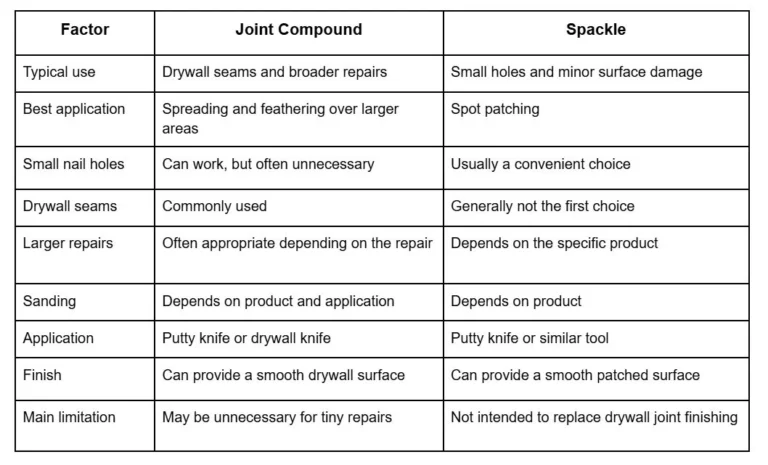
The difference becomes clearer when you look at actual repair situations. If you removed a picture frame and have four small nail holes, there is little reason to prepare a large amount of joint compound. A suitable spackling product can make that repair simple.
If you are finishing the seam between two drywall sheets, that is a different job. Joint compound and drywall tape are part of the standard process for producing a finished joint.
Which One Should You Use?
The right material depends on the damage.
1. Small Nail Holes
For ordinary nail holes in painted drywall, spackle is generally the practical choice. Clean out any loose material around the hole, apply the patching compound, let it dry according to the product directions and sand the area smooth if necessary.
The important part is not to leave a raised mound around the hole. A patch can look smooth to the touch but still show through paint if its edges are not properly feathered.
Very small holes may require only a small amount of material. Applying more than necessary can create additional sanding work.
2. Small Dents and Minor Damage
Spackle is also commonly used for shallow dents and small areas of surface damage. Before applying it, check whether the drywall paper is torn or lifted. Loose material should not simply be covered over. Damaged edges may need to be trimmed or secured before the patch is applied.
For a shallow dent, spread the material slightly beyond the damaged area and feather the edges. The goal is to make the transition gradual rather than leaving a noticeable ridge.
Deeper damage may require more than one application. Trying to fill a significant depression with one thick layer can lead to an uneven repair or a longer drying period. Multiple thinner applications may produce a better result, depending on the product and repair.
3. Drywall Seams
Joint compound is generally the appropriate material for finishing drywall seams. A proper drywall seam is more than a crack that needs to be filled. It involves the joint between two panels, drywall tape, multiple applications of compound and careful feathering.
Using an ordinary patching product as a substitute for a complete drywall joint finishing process can produce a repair that is difficult to blend or that does not adequately address movement at the seam.
If a seam has cracked after years of being painted, do not assume that simply covering the visible crack will solve the problem. The condition of the tape, drywall joint and surrounding material should be evaluated first.
4. Larger Drywall Repairs
Larger holes and damaged sections require more consideration. For example, a small puncture and a hole large enough to require a piece of replacement drywall are completely different repairs. A larger opening may need backing, a drywall patch, joint tape or another appropriate reinforcement method and several layers of finishing material.
Joint compound can be appropriate for finishing many larger drywall repairs, but the compound itself is not a substitute for replacing missing drywall.
This is an important distinction. If part of the wall is missing, you need to repair the structure of the drywall opening before applying finishing material.
5. Before Painting
Neither spackle nor joint compound should simply be covered with paint while it is still wet or unfinished. A repaired area generally needs to be:
- Fully dry according to the product’s requirements.
- Sanded or otherwise smoothed as appropriate.
- Free of loose material and sanding dust.
- Checked from different angles for ridges, depressions or visible edges.
- Primed when appropriate for the repaired surface and paint system.
- Painted with the finish coat after the underlying preparation is complete.
The repaired spot can absorb paint differently from the surrounding wall. That is one reason a repair may remain visible even when the patch itself feels perfectly smooth.
Planning a Painting Project?
Can Joint Compound Be Used Instead of Spackle?
Yes, joint compound can be used for many small wall repairs, provided the product is appropriate for the application.
The bigger question is whether it is the most convenient choice. For a few nail holes, using joint compound may simply add unnecessary steps. A suitable spackling product is often easier for quick spot repairs.
Joint compound becomes more useful as the repair gets larger or involves drywall finishing rather than simple hole filling.
The product’s instructions still matter. Not every compound is intended for every application and drying, thickness, sanding and application requirements can vary.
Can Spackle Be Used Instead of Joint Compound?
Sometimes, but not as a universal substitute. A spackling product can be perfectly appropriate for small holes and minor damage. That does not make it the right material for finishing drywall seams.
Drywall joints have specific finishing requirements. They need to be reinforced and blended so that the joint does not remain visible after painting.
For that type of work, use a product intended for drywall joint finishing and follow the appropriate joint finishing process.
Which One Is Easier to Sand?
There is no single answer because formulations vary. Some spackling products are specifically formulated to make small repairs easy to sand. Certain joint compounds can also sand readily, particularly when used correctly and allowed to dry properly.
The amount of material matters too. A thick patch of either product can create more sanding work than a thin, properly feathered application. Applying excessive material and then trying to sand it flat is usually less efficient than controlling the thickness during application.
If sanding is required, use appropriate personal protection and avoid creating unnecessary airborne dust. The product label and applicable safety instructions should guide your approach.
Which One Dries Faster?
Drying time varies by product, application thickness, temperature, humidity, ventilation and the type of material being used.
That means there is no reliable universal rule that spackle always dries faster than joint compound or vice versa. Lightweight patching products may be formulated for relatively quick repairs, while different joint compounds have different drying or setting characteristics.
The safest approach is to follow the manufacturer’s stated instructions for the specific product rather than relying on a generic drying time rule.
More importantly, do not paint simply because the surface feels dry. The material needs to be adequately dry or set for the next stage of the repair.
Planning a Painting Project?
Common Mistakes to Avoid
1. Using the Same Material for Every Repair
Having one product on hand does not mean it is suitable for every type of damage. A few nail holes and a failed drywall seam require different approaches.
2. Applying Too Much Material
More compound does not automatically mean a stronger or better repair. Excess material creates a larger area to sand and can make the repaired section more difficult to blend into the surrounding wall. Apply enough to fill and cover the repair, then build additional layers when the job calls for them.
3. Ignoring Loose Drywall Paper
Painted drywall can develop torn paper around a damaged area. If loose paper remains underneath the repair, the patch may not sit properly or may leave a visible irregularity. Remove or stabilize damaged material as appropriate before finishing the surface.
4. Painting Before the Repair Is Ready
A fresh patch can absorb paint differently from the surrounding wall. Painting too soon can also interfere with the repair if the material has not adequately dried or set. Follow the product directions and make sure the surface is properly prepared before painting.
5. Skipping the Sanding and Inspection Step
A repair that looks fine from straight on may still have a visible edge when light hits the wall from the side. Use good lighting and inspect the repair from different angles before painting.
6. Assuming a Crack Is Just a Cosmetic Problem
A recurring crack deserves more attention than a simple nail hole. Cracks can result from movement, damaged drywall joints, changes in the building, moisture or other conditions. Filling the crack without understanding why it keeps returning may only provide a temporary cosmetic fix.
How to Prepare a Repaired Wall for Painting
Once the repair itself is complete, the quality of the paint job depends heavily on the preparation that follows.
1. Allow the Repair to Dry or Set
Follow the instructions for the exact product used. Drying and setting are not interchangeable terms and products behave differently. Temperature, humidity, material thickness and ventilation can also affect how quickly a repair becomes ready for the next step.
2. Smooth the Surface
Sand the repair as appropriate for the material and finish you need. Do not focus only on the center of the patch. The edges matter just as much because a hard ridge can remain visible beneath paint.
3. Remove Dust
Sanding leaves fine dust on the wall. Remove the dust using a method appropriate for the surface and coating system before painting. The goal is to leave the surface clean enough that dust does not interfere with adhesion or leave a rough texture.
4. Inspect Under Good Lighting
Look at the wall from multiple directions. A small ridge, depression or sanding mark that is difficult to see straight on may become obvious once light strikes the wall across its surface. If necessary, correct the imperfection before proceeding.
5. Prime When Appropriate
A repaired area can behave differently from the surrounding painted surface. Primer may be appropriate depending on the repair, substrate, existing coating and paint being used.
Priming is particularly worth considering when the repaired area has exposed drywall or another surface that needs to be sealed before the finish coat. Product instructions should guide the choice.
6. Apply the Finish Paint
Once the surface is properly prepared, apply the finish coating according to the paint manufacturer’s directions.
Do not expect paint alone to hide poor patching. Paint follows the surface underneath it. If the repair has a ridge, depression, texture difference or visible edge, the finish coat may make that problem more noticeable rather than correcting it.
Planning a Painting Project?
When Should You Call a Professional?
Small nail holes and minor dents are often reasonable DIY repairs. More complicated wall damage can require considerably more skill, particularly when the finished surface needs to disappear into an existing wall. Professional help may make sense when you are dealing with:
- Extensive drywall damage.
- Large holes or missing sections.
- Recurring cracks.
- Water damaged walls.
- Damaged drywall tape.
- Large areas requiring resurfacing.
- Difficult wall textures.
- Repairs that need to blend with an existing finish.
- Numerous repairs throughout a room or property.
- A wall that needs repair and repainting as part of a larger project.
Water damage deserves particular caution. Replacing or patching the visible drywall does not address the source of the moisture. The underlying cause should be identified and corrected before cosmetic repairs are completed.
Texture matching can also be deceptively difficult. A repair may be structurally sound but still stand out because the surrounding wall has a specific texture, sheen or application pattern.
For larger repair and painting projects, the advantage of professional help is not simply applying compound. It is knowing how the repair, surface preparation, primer, texture and final coating need to work together.
Big League Painting can be considered when a drywall repair is part of a broader painting project and the final appearance needs to blend with the surrounding wall.
Conclusion
The choice between joint compound and spackle is less about which product is “better” and more about matching the material to the repair.
For small nail holes, shallow dents and minor wall damage, spackle is generally the practical choice. For drywall seams, broader finishing work and many larger repairs, joint compound is usually more appropriate.
The quality of the final result depends on more than the container you choose. Proper application, drying or setting time, sanding, dust removal, surface inspection, priming when appropriate and careful painting all matter.
If you are preparing a wall for a fresh coat of paint, Big League Painting can be an option when the project involves more than a few simple patches and you need the repaired areas to blend with the finished wall.
The simplest rule to remember is this: use spackle for small spot repairs and use joint compound when the job involves drywall finishing or a larger area. When the damage does not fit neatly into either category, evaluate the condition of the wall first rather than choosing a product based only on convenience.